
Custom Creations
When standard rectangular screens cannot accommodate the unique architectural forms of a space — curved domes, spiral staircases, cylindrical structures, irregular corners — custom LED display solutions become the bridge between spatial aesthetics and digital content. From spiral ribbon screens in shopping mall atriums to wave-shaped curved walls in brand flagship stores, from spherical immersive installations in science museums to monumental art screens in outdoor plazas, custom LED displays are redefining the boundaries of what a "screen" can be. We offer end-to-end custom services from concept design to delivery — making every screen the most distinctive visual focal point in any space.
Discuss Your Project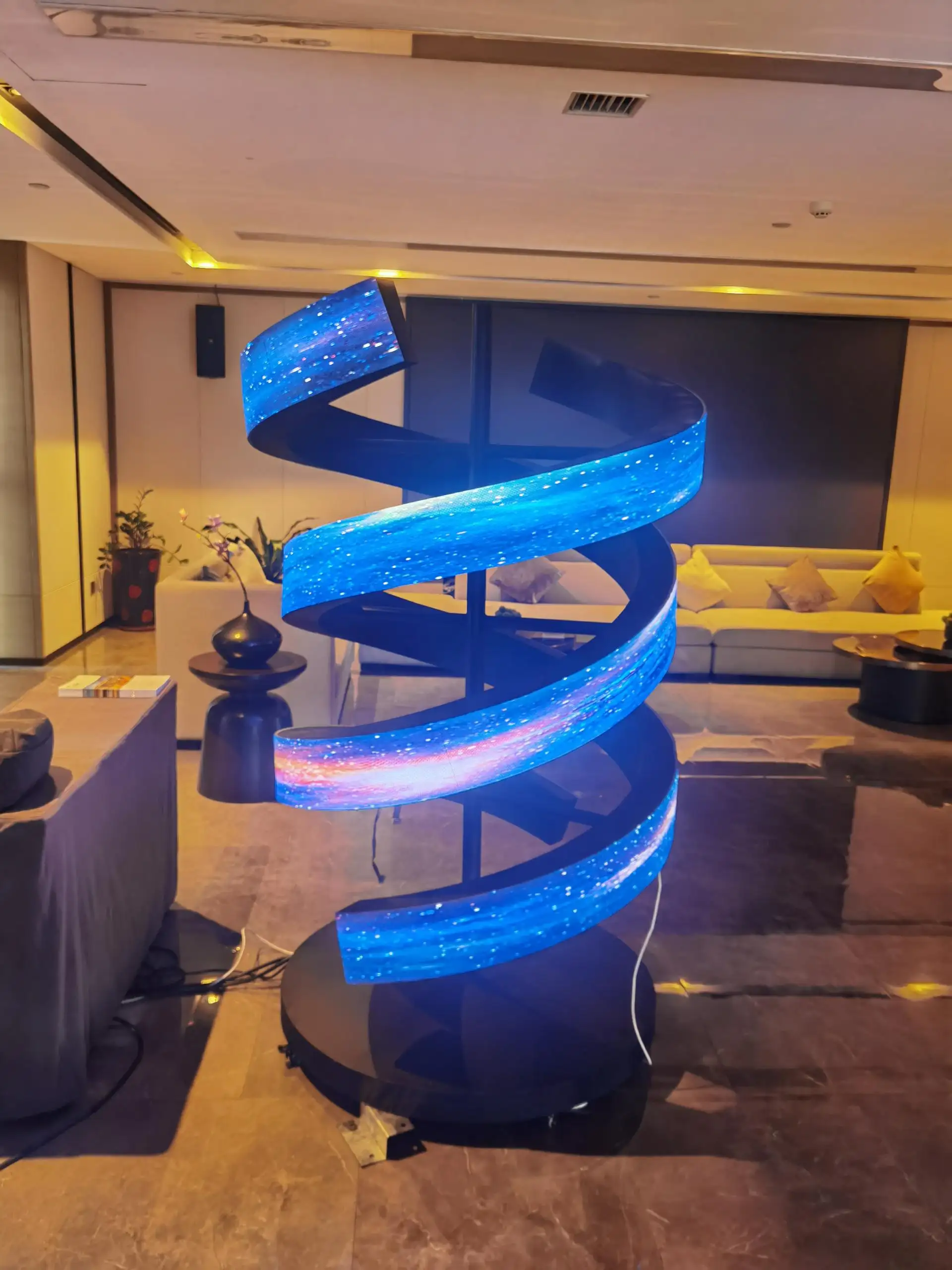
Custom-shaped screen
Five Pain Points, One Answer
Creative shapes cannot be achieved with
standard screens
Architectural spaces come in endless forms — dome curvatures, cylindrical
surfaces, stairway corners, irregular facades — standard rectangular screens
cannot conform to these structures, and forced installation compromises the
spatial aesthetic. We offer flexible modules and custom-shaped
solutions that support bending, folding, and twisting — enabling
cylindrical screens, spherical screens, wave screens, ribbon screens, and even
Möbius strip creative installations. We also support right-angle, curved, arc,
and irregular structural customization, flexibly adapting to building facades
and commercial spaces
Custom projects carry high risk —
concerns about final results
Custom screen projects involve multiple stages: structural design, module
adaptation, content production — any misstep can lead to project failure. We
provide end-to-end service from concept design to delivery: on-site
surveys and solution design in the early stage, 1:10 scale model verification
mid-stage to validate form feasibility and display performance before
production. Modular structural design supports both front and rear maintenance
access, effectively reducing installation and maintenance complexity
High installation precision requirements
— seam control challenges
Splicing precision directly impacts visual quality — excessive gaps compromise
image continuity, and sharp-angle designs may cause module gaps exceeding 1.5mm.
We employ high-precision module design and professional installation
teams — through custom modules and precision splicing techniques,
ensuring continuous and complete imagery-. For curved structures, flexible
modules precisely conform to the surface for corner structures, we support 90°
seamless corner splicing to enhance visual immersion
Content adaptation difficulties —
suboptimal playback
Custom-shaped screens require specially produced content to achieve maximum
impact — yet many projects underestimate content adaptation costs We
provide content adaptation guidance and playback optimization —
recommending appropriate content production directions based on screen shape
and viewing angles to ensure perfect alignment between content and screen form.
High refresh rate configurations (≥3840Hz) ensure smooth dynamic content and
flicker-free camera capture
High maintenance costs for custom
projects
Custom screens have complex structures — post-maintenance often requires
disassembling large sections just to replace a faulty module We adopt modular
design and accessible maintenance solutions — each independent unit
can be individually removed and replaced Arc structures feature maintenance
access points every 120°, grid structures reserve service gaps every 3×3 module
units. High-strength magnetic attachment ensures easy and stable installation,
significantly reducing post-maintenance costs and complexity
Product Solutions
|
Solution Type |
Best For |
Key Advantage |
Recommended Pitch |
Brightness |
Protection |
|
Flexible Curved Screen |
Curved walls / domes / column wrapping |
Bendable and foldable, conforms to any curved surface |
P1.25-P2.5 |
≥800 nits (indoor) / ≥4,500 nits (outdoor) |
Indoor standard / IP65 |
|
Creative Shaped Screen |
Brand showrooms / art installations / pop-ups |
Sphere / ribbon / drop — any custom shape |
P2.5-P4 |
≥800 nits (indoor) / ≥4,500 nits (outdoor) |
Indoor standard / IP65 |
|
Transparent Creative Screen |
Glass curtain walls / windows / building facades |
Transparent, preserves views, integrates with architecture |
P3.9-P10 |
≥3,000 nits |
IP65 |
Selection Guide:
- Curved walls / domes / columns → Flexible Curved Screen (conforms to curves, seamless imagery)
- Brand showrooms / art installations / pop-ups → Creative Shaped Screen (any shape, one of a kind)
- Glass curtain walls / building facades → Transparent Creative Screen (preserves daylight, integrates with architecture)
Key Specifications
|
Category |
Specifications |
|
Display Performance |
Indoor brightness ≥800 nits · Outdoor brightness ≥4,500 nits · Refresh rate ≥3840Hz, flicker-free on camera · Accurate color reproduction |
|
Structural Capability |
Flexible modules support bending/folding/twisting · Supports cylinder/sphere/wave/ribbon and any custom shape · Right-angle/curved/arc/irregular structure customization |
|
Installation Methods |
Wall-mount / hanging / film application / recessed · Modular structure, front and rear maintenance accessible |
|
Protection (Outdoor) |
IP65 rating · Waterproof and dustproof · Adapts to all climate conditions |
Use cases
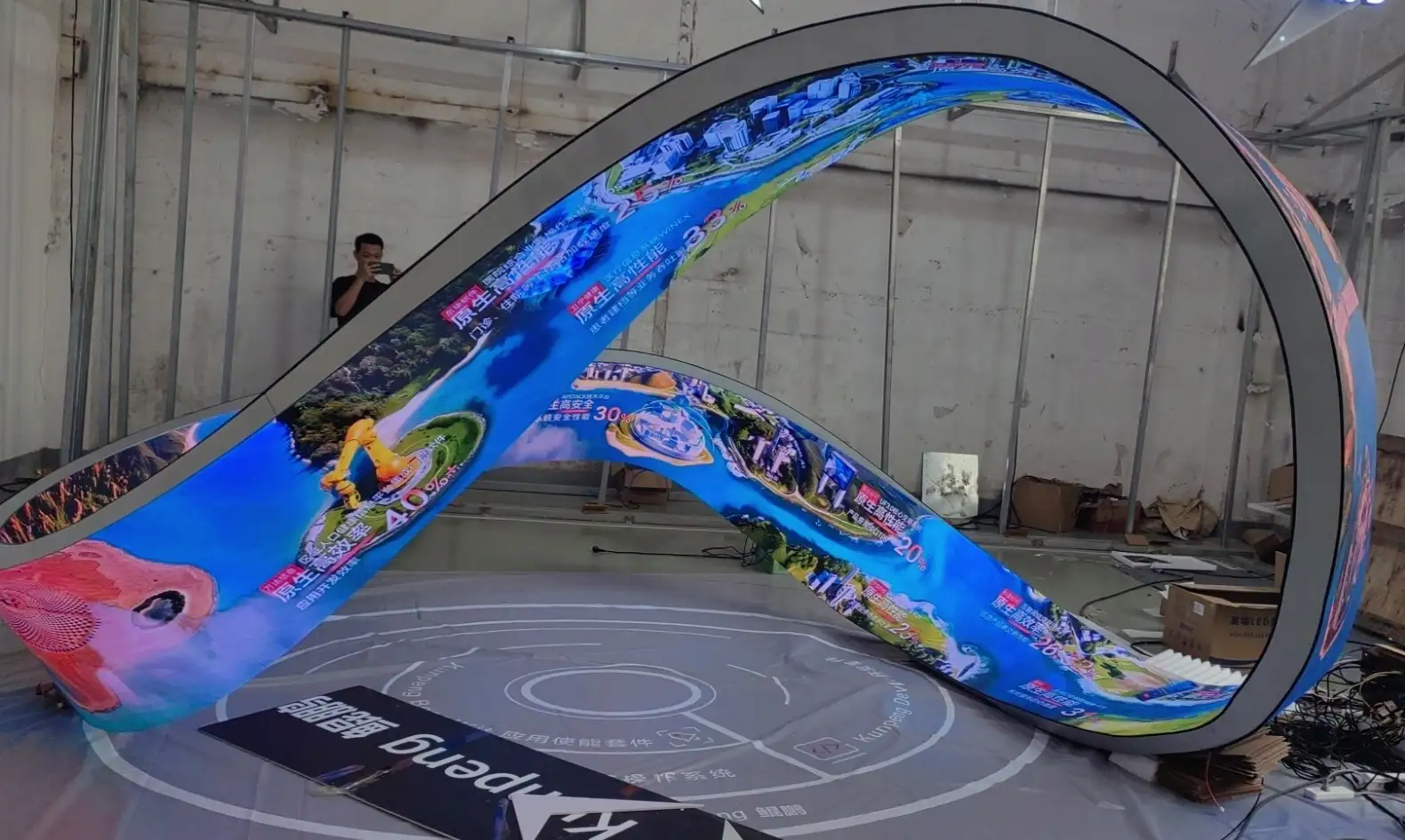
Project Name: A Exhibition Hall Möbius Strip-Shaped LED Display
Project Date: July 2026
Project Area: 10.2 m²
Project Product: Custom P1.87 LED Module
Frequently Asked Questions
Interested in This
Solution?
Tell us about your space and requirements. Our team will design a customized LED display solution for your project.